
Landing pages, or tests on the site you already have?
Coframe does two things. Experiments improve the website you already have: Jarvis changes headlines, layouts and flows on your pages, and visitors are split to see what works. Landing Pages builds new pages that Coframe hosts on your domain. They share one engine and one way of reading results. Here is how to choose.
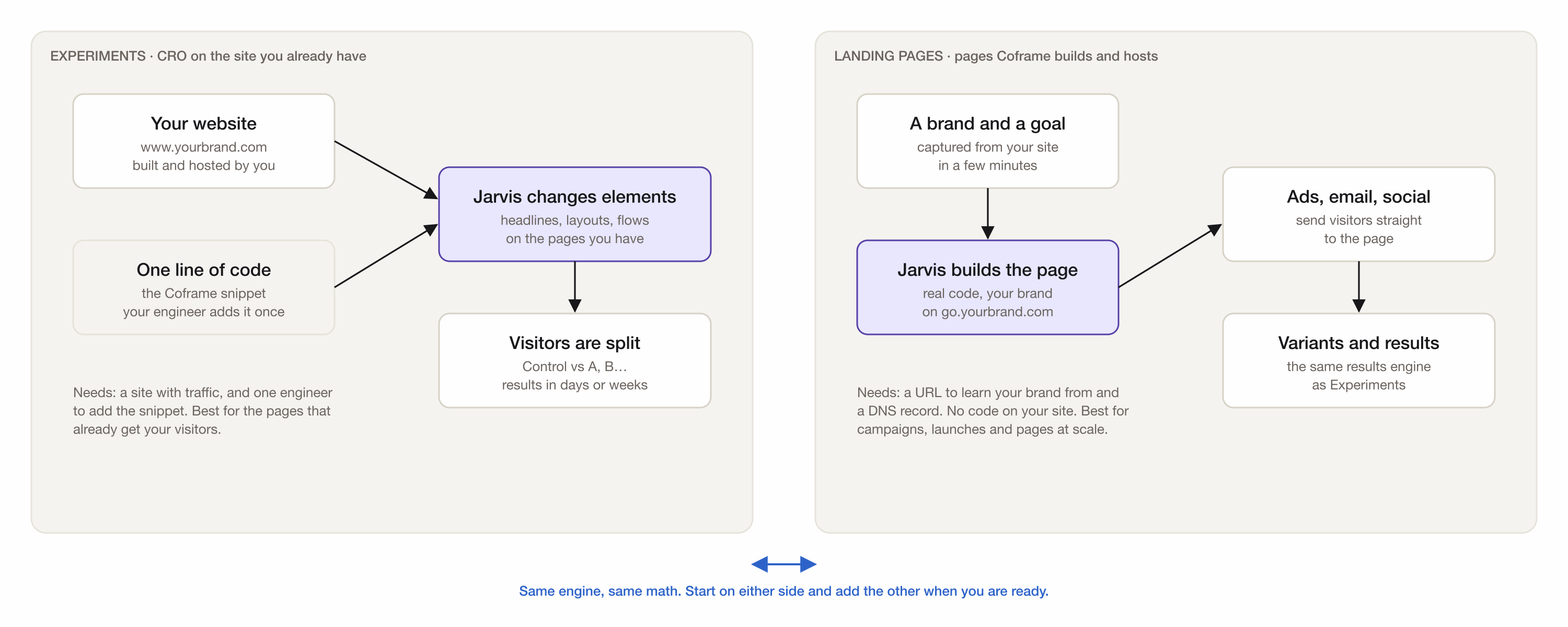
Tap the diagram to open it full size.
Side by side
Where it runs
- Experiments on your site
- Your website
- Landing Pages
- Pages Coframe builds and hosts, on your domain
What you need
- Experiments on your site
- One line of code on your site, and traffic
- Landing Pages
- A website to learn your brand from, and one DNS record
Who has to help
- Experiments on your site
- An engineer, once
- Landing Pages
- Nobody, unless you want your own domain
Best for
- Experiments on your site
- The pages that already get your visitors
- Landing Pages
- Campaigns, launches, and pages at scale
Time to a first page
- Experiments on your site
- Days, after the snippet is live
- Landing Pages
- About an hour
Time to a first result
- Experiments on your site
- Depends on your traffic
- Landing Pages
- Depends on the visitors you send
Start with landing pages when
Your snippet is waiting on a security or IT review.
You're launching a campaign and need pages this week.
You want to test offers and messages before you touch the main site.
Start with experiments when
The pages you want to improve already exist and already get traffic.
Your biggest wins are on the home page, pricing or checkout.
They connect
A landing page can join your experimentation project, so its results sit beside your other tests. The winner of a landing page test becomes the page. What you learn on a landing page carries over to the main site. Most teams end up with both.